Milestones of the Cannes Film Festival
Booed films, bare breasts, clenched fists and cinema masterpieces, all form part of the Cannes Film Festival's legendary nearly 80-year history.
- 1939: The first edition of the festival is slated for September 1-20 but is cancelled due to the outbreak of World War II.
- 1946: The first full festival finally opens, amid a carefree atmosphere after the WWII years. Among the highlights, Roberto Rossellini's "Roma, citta aperta" (Rome, Open City), wins a Grand Prix and reveals a major new current: neorealism..
- 1947: The new palace being built to house the festival is not finished. A tarpaulin laid instead of a roof is carried off in a storm on the eve of the awards ceremony.
- 1948 et 1950: The festival is not held due to a lack of funds.
- 1954: The first of Cannes' many scandals erupts when young British actress Simone Silva is photographed topless with Robert Mitchum at a picnic. The starlet is told to pack her bags.
- 1955: Alfred Hitchcock's young American star, Grace Kelly, participates in the festival representing George Seaton’s "The Country Girl". She meets Prince Rainier of Monaco and they marry on 22 April 1956, on the eve of the opening of the next festival.
- 1956: Alain Resnais' documentary on the WWII concentration camps, "Nuit et Brouillard" (Night and Fog), which confronts Germany with its Nazi past, is withdrawn from the selection at the request of Berlin, so as not to damage Franco-German ties.
- 1959: Young French New Wave director François Truffaut, 28, wins the award for best director for his Quatre Cents Coups (The 400 Blows).
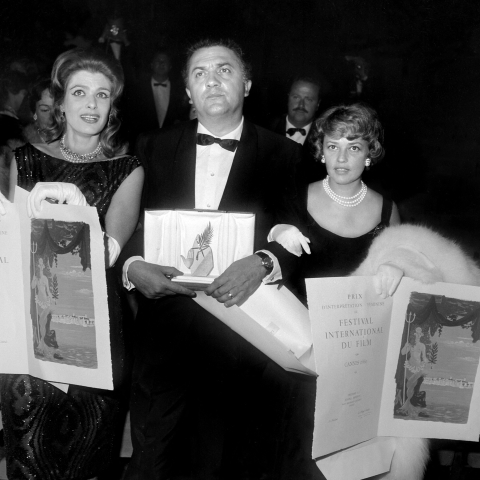
- 1960: Federico Fellini’s "La Dolce Vita", considered pornographic by some people and criticised by the Vatican, receives the Palme d'or, and is booed.
- 1965: US actress Olivia de Havilland becomes the first female president of the jury.
- 1968: In May 1968 French social unrest reaches the festival, which is shut down early amid pressure from filmmakers, who occupy the palace.
- 1973: In the 1970s, directors tackle unusual, delicate subjects, which unsettle the audience. First comes Marco Ferreri with "La Grande Bouffe" (Blow-out in English), in which a group of men shut themselves in a house with prostitutes and eat themselves to death. Two years later, Thierry Zeno’s Vase de Noce deals with zoophilia.
- 1975: Paul Newman becomes the first to trigger a strike among photographers. After refusing to pose for photographers after a tiring journey, journalists lay their cameras by their feet as Newman enters the festival hall later in the day. Isabelle Adjani is given the same treatment in 1983
- 1983: A new Palais des Festivals et des Congres, nicknamed "the Bunker" opens on the site of Cannes' former casino, where the festival first started.
- 1985: French new wave director Jean-Luc Godard, who has come to Cannes to present "Detective", receives a custard pie in the face.
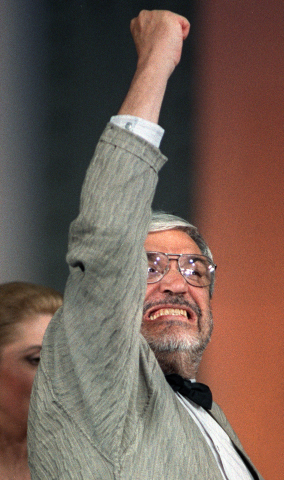
- 1987: To whistles from the audience, Maurice Pialat wins the Palme d'Or for "Sous le Soleil de Satan" (Under the Sun of Satan). He raises his fist and declares: "If you don't like me, I can tell you that I don't like you either".
- 1993: Jane Campion, director of "The Piano" becomes the first woman to receive the Palme d'Or.
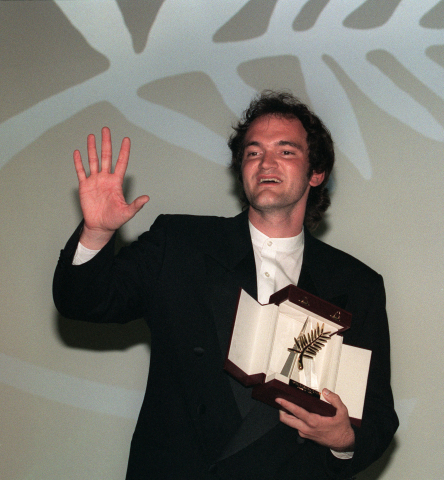
- 1994: Quentin Tarantino receives the Palme D'Or for "Pulp Fiction".
- 1997: The Festival celebrates its 50th anniversary. A "Palme des Palmes" is awarded by all directors who have won the Palme d'Or to Swedish film director Ingmar Bergman, who has up to then never been awarded a prize by the festival.
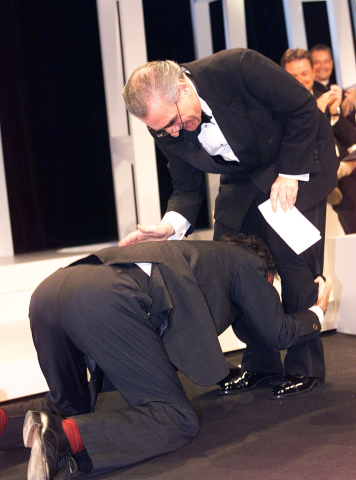
- 1998: Italian actor-director Roberto Benigni kisses jury president Martin Scorsese's feet after winning the Grand prix for his film "Life is Beautiful".
- 1999 : Booing greets radical choices of the jury presided by Canada's David Cronenberg. The Palme goes to "Rosetta" by the Dardenne brothers and only a certificate of merit to Spain's Pedro Almodovar, a darling of the festival goers, for "All About my Mother".
- 2004: Against a background of the war in Iraq the jury chooses "Fahrenheit 9/11", a virulent attack by Michael Moore on President George W. Bush's foreign policy.
- 2007: For the Festival's 60th anniversary, 35 filmmakers make a film made up of sketches. They include Cronenberg, Wim Wenders, Roman Polanski, Manoel de Oliveira, Youssef Chahine and Wong-Kar-Wai.
- 2011: Lars Von Trier, in competition with "Melancholia" stirs controversy with ambiguous statements on Hitler and Nazism. Despite his apologies, the festival organisers declare the Danish director "persona non grata".
- 2013: With "Blue is the Warmest Colour" the jury awards for the first time the Palme d'Or to a director, Frenchman Abdellatif Kechiche, and his two actresses, Lea Seydoux and Adele Exarchopoulos.
- 2017: For the Festival’s 70th anniversary a family photo is taken with over one hundred artists, including Palme d’or winners, Presidents and Jury members.
- 2027: The festival’s 80th anniversary will be held from May 11 – 22.